Monday, March 16, 2009

IAG Future Challenges (Birmigham 1999)


At IAG General Assembly Birmingham 1999 there was a session discussing about an IAG structure to meet the future challenges. Six papers were presented during the session;
  1. An analysis of the current IAG structure and some thoughts on an IAG focus (KP Schwarz)
  2. The pros and cons of having sections in IAG (F Sanso)
  3. IAG services in the crrent framework of the IAG (G Beutler)
  4. The role of IAG Special Stud Groups (D Wolf)
  5. Scientific services in support of research in geodesy and geodynamics (M Feissel)
  6. Reflections on a new structure for IAG Beyond 2000 - conclusions from the IAG Section II Symposium in Munich (G Beutler, H Drewes and R Rummel)
- - - - -

Friday, March 13, 2009

Major development reported at IAG Birmingham


Major development in geodesy achieved reported at IAG Birmingham;
  1. the active role of IERS in defining and implementing a global reference frame and the emergence of GPS as a major tool to accomplish frame realization at regional and local scales due to advances made in modeling, techniques, and quality control.
  2. the SIRGAS project which exemplified how a reference network for a whole continent can be established in a relatively short time, given the information base provided by Services such as IGS and IERS and the cooperation between the different countries in this part of the world.
  3. EUREF and EUVN which are the ongoing efforts in Europe to integrate classical network information with space geodetic data. This work, done under the auspices of Commission X, is exemplary for countries considering such action because it provides insight into the effort required and the gain achieved.
  4. The active role of Commission VIII, commonly known as CSTG, in coordinating the different space techniques used for geodesy and geodynamics. It has led to a proposal for new IAG Services in SLR and VLBI to be decided upon at this meeting. It also has resulted in a major international project exploring the potential of GPS/GLONASS integration.
  5. The continuing efforts of the Wegener Commission to use space and terrestrial methods for the solution of regional geodynamics problems in Europe and similar efforts, such as Geodyssea, in other parts of the world.
  6. The publication of the new Global Geopotential Model EGM96 by NASA/OSU/NIMA after comprehensive testing of alternative solutions by a working group of the IAG Geoid Service. It was exemplary in showing the contribution IAG can make to such an effort.
  7. The coming of age of airborne gravimetry as a method of high-resolution local geoid determination and as a potential tool for resource exploration.
  8. The advances made in using GPS for the remote sensing of the atmosphere and the potential impact of such techniques on science and every day life.
  9. The work performed on Temporal Variations of the Gravity Field, which is exemplary for its interaction with other groups working in the field and its high level of participation.
- - - - -

Tuesday, March 10, 2009

IAG Birmingham 1999 - important activities & development


Following are the activity plan of IAG for the next four years;

After the initial discussions in November 1995 and Potsdam meeting in April 1997 Rummel presented a proposal for a Global Integrated Geodetic and Geodynamic Observing System (IGGOS) that incorporates many of the current activities and relates them to a common framework. The proposal would not only give a focus to IAG research, but would also result in a much higher visibility of the IAG contribution to Earth Sciences in general.

To start the satellite gravity mission - the second priority recognizes the difference in accuracy that currently exists between the various methods of global positioning (SLR, VLBI, GPS) on the one hand and the methods of global gravity field and geoid determination on the other. One obvious reason for the lower accuracy in gravity field approximation is the lack of dedicated satellite missions for gravity field research. Such missions would result in a much more consistent global resolution of the gravity field than is available today.

In 1995, when this discussion started, no mission in this area had been approved. There is the realistic possibility that three dedicated gravity missions may be launched within the next five to six years and that we actually may be entering a decade of potential field satellite missions.

- - - - -

Saturday, March 7, 2009

IAG 1999 Birmingham (Geodesist passes away)


IAG President (KP Schwarz) speech during the opening of IAG 1999 General Assembly at Birmingham began with mentioning of words to remember geodesists who left us since the last General Assembly. We lost eleven as follows (i.e., 1995-1999);

Isetan Hazay, Hungary in 1995
Attalah M.Wassef, Canada in 1995
Guy Bomford, UK in 1996
Erik Tengström, Sweden in 1996
Yuri D. Boulanger, Russia in 1997
Stanislaw Krynski, Poland in 1997
Tauno J. Kukkamäki, Finland in 1997
Svend Saxov, Denmark in 1998
Rudolf Sigl, Germany in 1998
Hermann van Gysen, S. Africa in 1998
Luman Wilcox, USA in 1999

Three former IAG presidents - Bomford, Boulanger, Kukkamäki - where among those who passed away during this period.
- - - - -

Wednesday, March 4, 2009

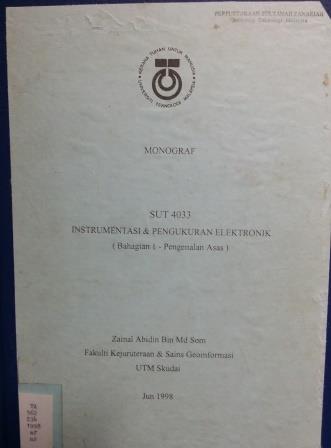
Monograf SUT4033 (1998)


Sebuah monograf nipis yang diguna pakai pada tahun 1998 masih tersimpan di Librari. Monograf ini digunakan sebagai bahan bacaan asas subjek instrumentasi dan pengukuran elektronik.


SUT 4033 Instrumentasi & Pengukuran Elektronik (1998)
- - - - -

Monday, March 2, 2009

WEF’98 “Do we need a gravimetric geoid …”


It’s now a long break period. Students are on their vacation until the new academic session in September. So its time to catch-up with some readings. Found an old paper by WEF (1998) “Do we need a gravimetric geoid or a model of the AHD to transform GPS heights in Australia”. Its in WF7 paper #9. The paper elaborated on why geoid and LVD is not coincide by giving a scenario example of Australia.

In answering the question mentioned in the title (WEF 1998) suggested that it is preferable to use a technique that accounts for the discrepancies between the vertical datum and gravimetric geoid model. This suggested approach yields a model of the separation between AHD and the WGS84 ellipsoid. WEF pointed out this serves as interim solution until readjustment of AHD/or re-definition of AHD.

Similar approach has been adopted for instance by Jiang & Duquenne (1996) – J of G; and in USA by Milbert 1995 – Geoid Bulletin 4.


- - - - -

Sunday, March 1, 2009

Geoid Meeting Budapest (1998)


The Second Continental Workshop on the Geoid in Europe was held in Budapest in March 1998.


The proceedings
- - - - -